Slipbox: Version 1.0
Jeff Uren ★ 2026-02-23
I hate note-taking apps, note-taking and to-do apps. I hate them. So. Much.
I've been using computers for a long time. My first computer was a Commodore 64 with a bootleg copy of GEOS and all the jumpman games.
Before that, every day after school I would wander over from my primary school to my Moms office across the street and sit at her IBM-style PC and play a math tutoring game that to this day I haven't figured out the title of, and Where in the world is Carmen San Diego.
Missing Bits
Why does no one talk about the difference between early Moleskines and what we get now in the shops? At some point they changed the paper drastically and it's never really been quite the same. I didn't use computers really for note-taking or anything approaching time management until I was in my late twenties. And even then, I still mostly kept a Moleskine (when the paper was still high quality) and a nice pen. I vaguely remember buying a lot of a specific yellow legal pad type that I really liked the feel of writing on. The only thing that's come close since is the extremely expensive Mnemosyne notebooks and pads I've become slightly addicted to.
All this is to say, I abosolutely hate note software and to-do apps. I'm not even going to wade into the cesspool that is project management and issue trackers, because that's just a whole other level of angry I don't want to explore right now.
"Oh I bet you've never tried..." Shush. I have, I've tried them all, across Windows, Mac, Linux, Terminal, Web, paid, free, FOSS, embedded in other IDEs, Emacs-based, vim-based. All of them. They're all the same form of terrible to me.
I need to qualify that a bit better. They're all terrible for me.
I'm not telling you to not use them. They may be perfect for you, and for what you want them for. For me, my relationship with knowledge software has been nothing less than hostile and that's probably more of a failing or aberration in me than it is a problem with these pieces of software.
Brainy bits
The miasma that is my brain, for whatever reason, does not take well to the general concept of a piece of software that I input my thoughts, ideas, observations, goals, and emotional state into. As much as I love computers and software engineering, that part of me that wants to record, research, and discover, feels repressed whether i'm typing into logseq, roam, OneNote, or writing in Apple Notes with a pen, or logging tasks in TaskWarrior, omnifocus or otherwise.
I feel robbed of something when I use these applications.
Maybe I expect too much? I can see the effort in these pieces of software, I know that the engineers behind them have put time and effort into these things to try and create great software (or really really bad software; looking at you Apple Notes) to make knowledge management, connections, and exploring your thoughts a first-class technology problem. But it doesn't seem to work for me.
So close, yet so disappointing
Please don't take this as a glowing review of these things, they were terrible, but they got me closer to the feeling I have with paper and pen than any of the others have. Let's talk about the closest I've gotten. Which is an Apple iPad with the pro pencil and Apple Notes and FreeForm. This has been the closest I've gotten to the feeling that I could get away with a digital solution. But the gaps are so wide that my iPad and pencil are currently just taking up space and collecting dust on a shelf in my bedroom, and have been for months. This past Saturday I thought about trading them in for a Steam Deck or a nice FujiFilm digital camera I saw in town at a second-hand games / electronics store.
Why did I abandon them?
In one sentence: terrible software & hardware
- The closest real-world approximation is that I once spilled coffee on a notebook. Apple notes would crash at a certain point and a significant volume of the notes I had just written would just disappear with no way to recover it.
- Heat. I would lay my iPad down on my desk, and start to write. The bottom right corner of the screen would start to heat up, to the point my hand would start to sweat and slip on the glass. I would have to postpone what I was thinking through to let the iPad cool down before I carried on.
- The jump between keyboard and pencil is jarring and you still have to use the keyboard a lot of the time.
- The text recognition hates me. It forces me into a style of writing that isn't comfortable, and makes me focus on the act of writing (making sure it recognizes my 'g') rather than the content of what I'm actually writing.
- Apple notes is too simple. You have "sort of" folders, but no way to "link" things, or any way to have more customized personalized structures of information and content.
Overall, I feel like Apple really dropped the ball hard here. Like really hard, almost purposefully. Apple pencil could have been so much more if the depth was there on the apps side. The feel of handwriting is great, the little helpers for making shapes. Even the selection of brushes, pens, sizes, etc... are mint. Care and attention went into these, only to have the surrounding software application do all of that effort and innovation a massive disservice. I can write, but I can't organize and connect any of that writing in meaningful ways.
Apple Notes just feels like the one that I had the highest hopes for, that really let me down, probably in no small part because of the cost it took to even try it out. It's a lot of money to have to shell out when your notepad still feels like a stronger contender than what a multibillion dollar company, focused on hardware and software teams, and usability and user experience cranks out.
Apple Notes actually made me feel bad about wanting more.
I don't like that. Which is why this felt more visceral than other applications. LogSeq, Roam Research, Obsidian, and all the other I've used are really impressive pieces of software, but at the end of the day, the physical tactility just isn't there.
Physicality
It helps me collect and process my thoughts. This article was started on a legal notepad. Once I'm done, I'll tear out the pages and type it up, between me and this pad of paper other than the nib scratching across the fibres of the paper there is little friction between my brain and the record.
My handwritten notes have their own set of problems though. How do you impart structure onto something that is for the most part free-form, stream of conscience, doodles in the margins, books I want to read, notes from articles i've read, work notes, ideas, observations, quotes, poems, and random other bits and pieces and bobs that collectively account for one hell of a mess?
Handwriting but not typewriting leads to widespread brain connectivity: a high-density EEG study with implications for the classroom One of the values in hand-written note taking is reinforcement. Writing something down has been scientifically-proven to embed learning in your brain much better than typing it out on a keyboard. The physical act of jotting something down, summariaizing or doodling out how something works exercises parts of your brain that a keyboard and mouse just can't.
I've used tools like excalidraw, plantuml, visual paradigm, mermaid, omnigraffle for decades. Diagrams I create in them I have to contually re-reference to refresh my memory as to how the things they diagram work.
If I start the diagrams on paper, the initial drawings might be innacurate, but the important bits are embedded into my memory and I have stronger recall for why I made a specific design choice than if I had started out diagramming it digitally.
The pragmatic among you might at this point be thinking "Jesus H. Christ, they're just effing notes, get over it!". I wish I could, but it annoys the piss out of me. So for the first time in my 20+ years of software engineering and development, I've taken the time out to just figure it out. Stop the constant attempts at fitting my brain into another engineers mold of what notes ought to be, and going my own way (sort of).
Where to Start
You're gonna laugh. Oh you're gonna laugh.
I did not follow Zettelkasten, but it's worth nothing it's out there. Note cards. Index cards. Zettelkasten if you want the most common implementation out there at the moment. Whatever you want to call them.That's where this all starts. But we're not following the old Zettelkasten standard much, if at all. We're going well beyond that into defining structure across the card index that support how I want to think about things, and what topics are important to me at any given point in time.
I didn't want to delve too hard into the Zettelkasten culture online, because I didn't want other peoples approaches to direct how I wanted to do things too much. Similar to things like bullet journalling , there's a lot of attention paid to the aesthetic of index card systems to the detriment of actually thinking about deep systems and how to design and use them sometimes.
Detour: Letting Go
Committing to paper meant acknowledging something I hadn't really thought about in all the time I was trying to get different digital solutions to work for me. Changing to the card setup meant letting go of something I'd internalized, or made myself responsible for without really thinking about the fact I'd done it.
The core of that was the idea that all this attempt to organize information in meaningful ways in a digital structure, was because I had a duty of care, a responsibility, and debt to some vague, hazy concept of "other people" to make that knowledge available to them. That eventually it should be shareable.
I egotistically felt that I owed it to the world, or other engineers, just someone, to have my thoughts digitized and available for them to use or pick apart. Where did this come from? I do not know. I am not a particularly active person on social media or even social in real life. I'm not a "sharer".
The realization that i'd put this unnecessary constraint on myself, and the dawning realization that I don't owe any of this information to anyone, meant I could rethink what it was I was really trying to accomplish, and how I wanted to store and experience knowledge.
Cheesy I know, but it does actually help. I now have a card at the front of my slipbox that just says: "THIS BELONGS TO YOU AND NO ONE ELSE. REMEMBER THAT" to remind me of this.
Evolution
I expect this system to evolve and change over time based on what I need it to be at any given time. But at the same time, I don't want it to be an amorphous blob of cards in a box (eventually boxes) that becomes a burden, and ultimately abandoned. I want things to come out of it in constructive ways. Articles, understanding, technical and architectural decisions. It has to support a broad spectrum of things and goals. That is a tall order for any system.
It was important to recognize that I was building a system. And that dynamism had to be baked into that system from the start. I could create lots of distinct, concrete sections and rules about how information gets structured into the cards, but that would cause friction the moment something didn't align with those predefined constraints.
I wanted to avoid friction at all costs.
Getting Started
I needed a jumping off point. Zettelkasten was alright, but defining zettelkasten, for any individual person is harder. Not to mention that alot of content on the internet is about how to do Zettelkasten digitally.
I needed a looser start and I found it in Pirsig. Some of my favourite books are the Phaedrus books by Robert M. Pirsig. In Lila specifically, Phaedrus describes his note card / index system. This is where I started. Phaedrus only describes a little of what his system entails, the main sections from a systems perspective. I haven't changed a lot from the way that it's described in the text, but I expect eventually it will.
I started with a few specific dividers:
- UNASSIMILATED
- Fresh notes, extracted claims, observations, half-formed ideas. New things that are ready to be fitted into the system or worked on in more detail.
- PROGRAM
- Cards to keep track of what I'm doing in the slipbox, tracking reworking areas, or things I'm thinking about doing. I like to think of these like old-school video game save points.
- CRIT. / GRIT
- Unfettered frustration & anger. If something isn't working in the index, and it's ticking me off it goes in here for me to look at later with a clearer head.
- TOUGH
- Things that feel important, but I'm not sure where in the wider system they should go yet.
- JUNK
- Slips that now look bad, duplicates. Kept around because they could be reborn into something better later.
That was my starting point, pretty sparse, but I immediately hit a wall. How do I structure information itself? What is important in information?
Pirsig, through Phaedrus, never tells us what his cards actually look like...
Another digression: Why cards are a good medium
Cards are small. You might be wondering how can you fit a complex thought onto a tiddly little index card? The truth is, that complicated thought you had is probably a lot of inter-related things, and you'll benefit greatly from trying to sum those things up in as few concise words as possible in order to get the salient point across. If a detail is important, maybe it needs it's own card.
I want to be clear, I still use notebooks to explore my thoughts, but a card or multiple concise cards going into the slipbox is the ultimate goal of that writing, even if it's self-inference or internal speculation about feelings and my state of mind.
Back to the slipbox and a bigger question:
What information is important to me right now?
To start, there's some basics: things that I want to read, things I need to get done, things I have done, and also just as important, right now, how do I structure knowledge into a slipbox to make it operable?
My slipbox could be self-describing. It was going to evolve to be self-describing, which is a weird thought.
Before I went too deep on that, I added three new sections / dividers.
- GTD
- Getting things done: each card in this section represents a task or group of tasks I need to work through and get done in my personal life or work life.
- 2026
- When I finish a task or card of tasks, they go here. Watching this section grow is actually really fulfilling, and it's nice to flick through them and see a physical representation of what you've accomplished.
- METHODS
-
I initially called this "META" but I found every time I looked at it I would think of Zuckerberg.
This is a cluster of cards and bundles of cards that describe my system and how I use it. - READING
- This is where I put books i've come across that I want to read. Super simple cards: title, author, edition, and a short reason I want to read it, and maybe some words to classify the content. Once i've read them I jot down the date I finished on the back of the card.
The Meaty Bits
So far we've been kind of dancing around the meat & gristle of how the index system works. We've described things that lead to the index, or described a bit of the concept of the knowledge system itself or things that don't have alot to do with accreting knowledge at all. There's a reason for that: it's ridiculously hard.
My first instinct was to start setting up dividers for topics or themes of knowledge to organize into. This. Is a trap. A card index on the face of it is deep but only in one dimension (the depth of the box). You could have sections and subsections but setting up pre-conceived notions of sections felt like I was layering constraint into the system too early.
So I stepped back and asked myself what it was I ultimately wanted to do? What did I want to get out of this?
- A reference that I can reach for and quickly find and review information or jog my memory about how something works.
- A way to ingest and structure information, ideas, content, philosophy, feeling and the world around me.
- A way to link and relate what i've learned and find new connections between disparate things.
- A way to explore the knowledge and bring things together into articles, technical decisions or plans.
These are some pretty lofty goals for a bunch of lined paper. A lot of pressure on the card index out the gate, but I was on a week off at this point, I had time. I could do this.
Some new dividers
I added a new divider to my slipbox. All it says is "CLUSTERS", and I threw out the dividers i'd started to create around specific topics and themes and added one other new type of card within a new divider.
DOMAINS
These are individual cards that have an overarching domain concept. Something fairly general like "philosophy", or "management", and "Learning".
On each thematic card, I list clusters that belong under that theme. This gives me a higher-level organisation, without it having to be represented by the structure of the slipbox dividers itself.
CLUSTERS
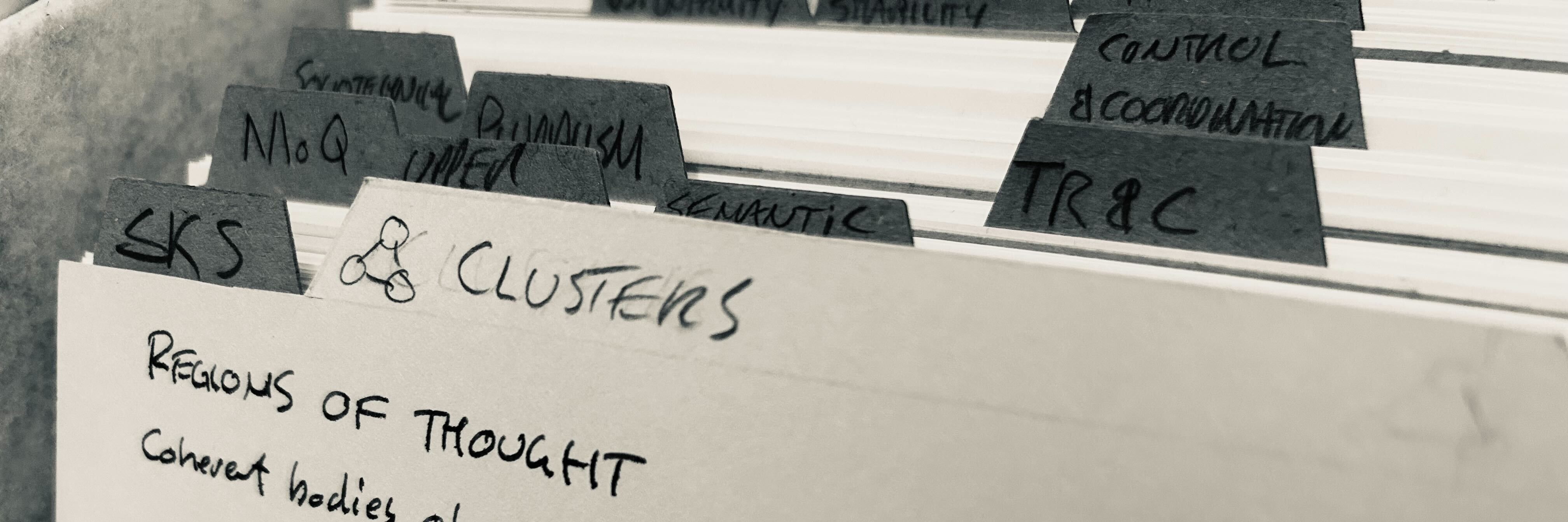
I want my slipbox to be alive or at least to feel alive. I've been working on developing an upper ontology system at my day job. Using RDF/Turtle and the OWL spec with some bits and pieces of the SKOS spec peppered in.
At work, I define a concept of a "Domain" and inside that we have DirectClasses, with Attributes, Relationships, Enumerations, and more. That is far too structured for what I want to do. But it shows that I had to shake off a desire to organize things too systematically when thinking about how I organize my own knowledge.
What I wanted was a way to group things together in some way. I landed on "systems". My whole life is a delicate interplay of many different systems, that sounds slightly reductionist to life in general, but I like thinking in systems. It helps me to reason about them and understand my experiences of them.
So my entire slipbox is a system, the finer details of which describe other systems through clusters, which are cumulatively a reflection of my understanding of how these systems interconnect on the whole. My wife won't like that approach if I put relationship things in there, but dammit, this is mine, she can make her own damn system, based around cats or something.
So when do cards form a cluster? Whenever really. If you've got enough cards that work together, and you can describe that working together fairly succinctly like: "Pluralism in systems of governance", or "operational stability & drift" then you've got a cluster. Clusters can break apart, merge, dissolve as they change and new connections are formed and more information becomes available.
They're loose groupings that help to organize the thoughts, not buckets to put things into discretely.
Where are we going with this?
So now I have the high-level structure of my slipbox. I've got clusters which represent systems of thought, and I have domain cards which group these clusters together under higher-level themes.
This is all getting very philosophical, but what is a card? What goes on the cards? How do I maintain some level of coherence? And how do we relate these cards?
We come back to the question of what it is that I really want.
- I want to understand concepts and what they are
- I want to understand how they work
- I want to understand the tensions and rules that govern them.
- I want to differentiate them from each other.
- I want to understand how things break
- ...and I want to know how all these things relate to each other
I could come up with some card types pretty quickly off the back of that.
- TENSION CARD
-
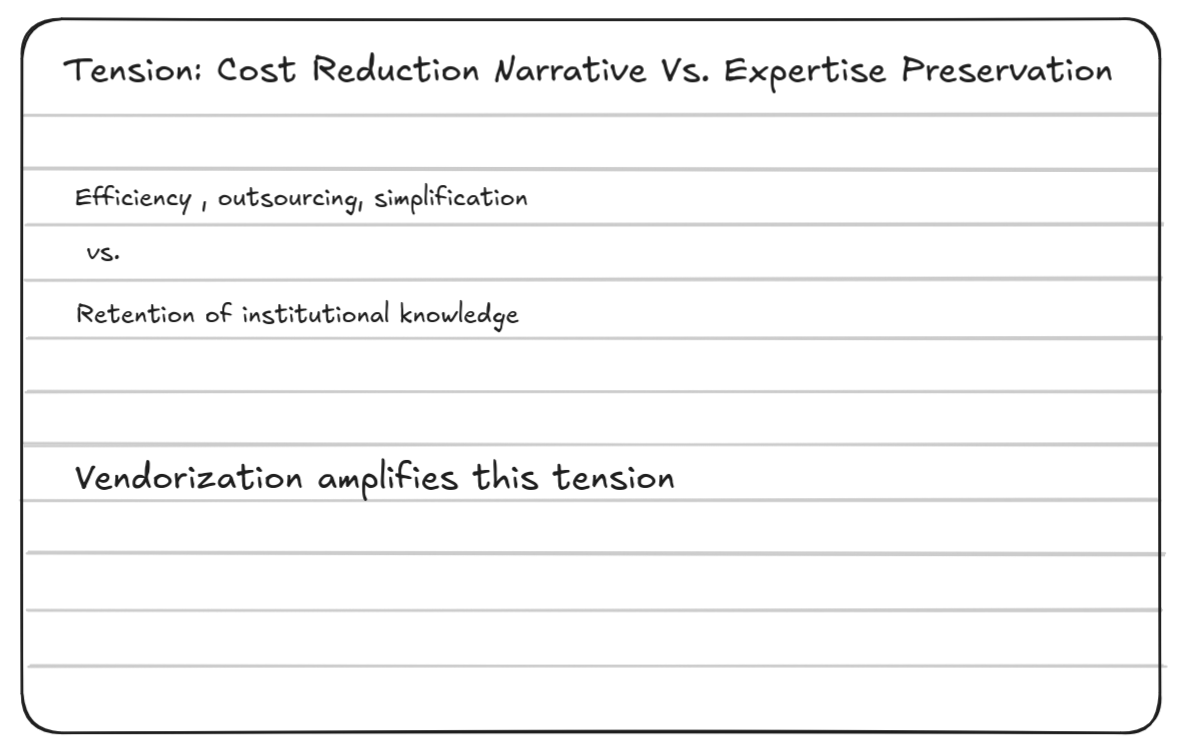 Describes two forces in opposition of each other. These are things
like "stability vs. change". They're fairly generic, and I can try
and whittle them down to their core so a tension can exist on its
own, independent of a cluster, and form a link between more than one
concept in a cluster or across clusters.
Describes two forces in opposition of each other. These are things
like "stability vs. change". They're fairly generic, and I can try
and whittle them down to their core so a tension can exist on its
own, independent of a cluster, and form a link between more than one
concept in a cluster or across clusters.
- MECHANISM CARD
- These describe the step-by-step of how an outcome is arrived at. If for instance we're talking about "Vendor Lock-in" as a concept, a mechanism of that could be: "Skill specialization around vendor tools creates vendor-lockin".
- PRINCIPLE CARD
- Principle cards are pretty rare so far. I've frontloaded a few into the slipbox, but they're such wide reacihing things that can touch many concepts, so I created a dedicated section for them. These are cards like "Conway's Law", or "Postel's Law". Cards in the cluster link to the principle cards they are governed by.
- DISTINCTION CARDS
- I have always struggled with dates and time. These tell me how something is different from another thing. Which is just as important as knowing how things are similar. For example, I have a cluster "Temporal Representation & Correction". In it I have a card that says "Leap Day != Leap Year" that lays out the fundamental differences between these two things to help me reason about them.
- FAILURE MODE CARDS
- I love these cards. They're like my guilty little pleasure. These describe how stuff breaks and falls apart. What goes wrong that brings the whole house tumbling down. If all the other cards in the slipbox are character development, these cards are the harrowing experiences those characters go through in pursuit of their goals. I absolutely love writing these cards.
Digression: This could be a whole lot more OTT
We'll get to the root of it all, the concept card, in a moment, but I want to specifically call out that I could have gone way overboard here with the card types, and I almost did.
I could have had trade-offs, hypothesis, claims, observations, heuristics, examples, counter-example cards, and on and on. Right up until I had some crazy ontology. But this needs to be maintainable. I don't want to spend loads of time and effort trying to figure out what kind of tidbit of information a card is, and I need to feel like I can step out of that structuring without slowing thought when I need to.
Concept Cards: The Beating Heart
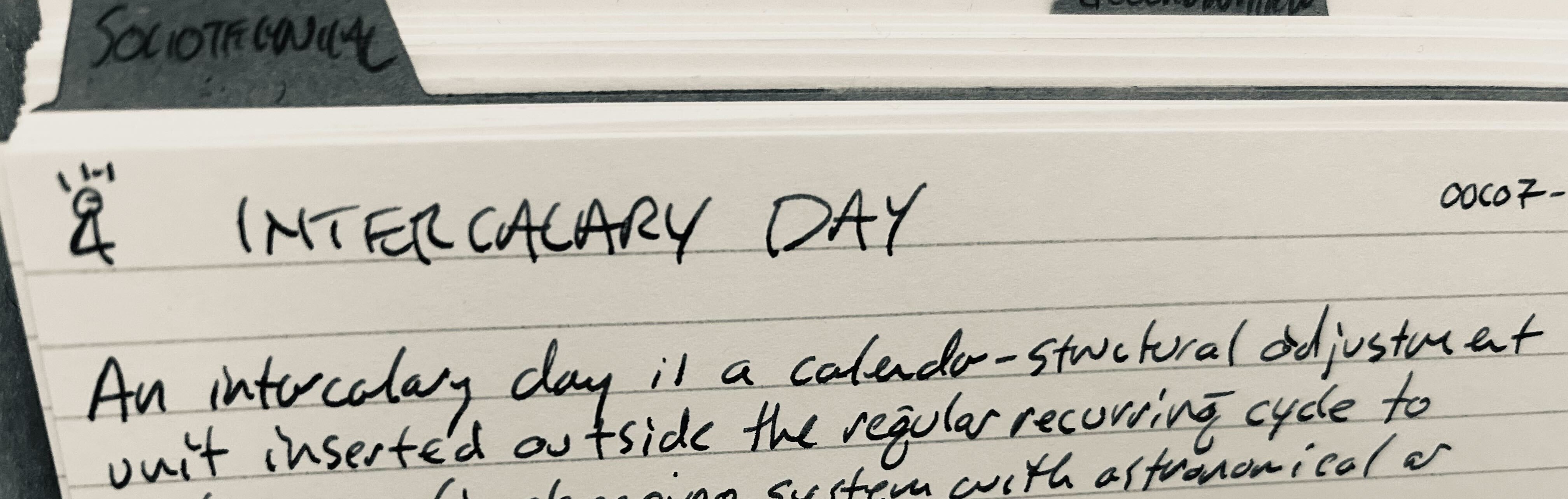
Let's get onto the concept cards, then we'll talk about relationships and some other glue-y bits after.
What in the hell constitutes a concept? Amiright? In my slipbox? Anything. Anything I can describe with some detail and is important to me in the moment or long-term.
I know what a Giraffe is.
The constraint i've set myself though is that I need to frame
the concept in the context of the system. I do not want a bunch
of definition cards. Having a card that tells me there's a thing
called "Giraffe" and that it's "yellow with a long neck" doesn't
provide me with a whole lot of anything to work with longer-term.
"A large browsing herbivore adapted to feed on high vegetation through extreme neck elongation and height advantage" tells me how a Giraffe operates, interacts, and integrates with other things which could form a cluster.
We should all have good boundaries. A concept could be a person, a place, thing, process, a system in and of itself, it could be just an idea. If i'm working out a concept within a cluster, I try to define what it means in the context of that system, its structural role, and the boundary of that thing. We're describing its role in the system, not its dictionary definition, and we're describing when it ceases to be itself.
A "Giraffe" isn't just its colour and pattern, its the traits and its function within the system that define it. These qualities are the important aspects, not the superficial identification mechanisms. I can remember what a Giraffe looks like, I don't need to re-identify it.
I'm not holding myself hard to this. They are guidelines intended to help me summarize a concept in concrete terms. But a concept card really could be anything, and equally important is that concepts can have relationships.
Relationships
These are hard. All relationships are hard. They're emotional, complicated, and can be strong, or hazy, and ill-defined.
There are a few different ways that I can define relationships in the slipbox. Each of them serving different purposes:
- Cluster Relationships
- A card simply exists in a cluster. It's existence there implies it has meaning in association with all the other cards in that cluster. If it doesn't, it should probably get moved where it does, or into JUNK, TOUGH, CRIT/GRIT depending on how I feel about that card.
- Direct Relationships
- A mechanism card could relate directly to a specific concept card or vice-versa, or a failure mode could be relatively simple in that it has a direct correlation to a specific principle, tension, concept or all three.
- RELATIONSHIP CARDS
- This is where things get interesting. Remember I said earlier i've been working on ontology systems? Well those naturally gravitate towards graph systems and graphs have EDGES which are usually a defined type of relationship.
Relationship cards don't just tell you a relationship exists, they qualify that relationship and explain the linkage.
I'll give you a concrete example from the slipbox. I have a concept called "Perceived Self-Interest Discounting" in a cluster called "Vendorization Dynamics". I then have a FAILURE MODE card titled "Risk Blindness Through Motive Discounting".
In my cluster, the first card has a causal relationship to the second. The concept described by the card causes the failure mode. The relationship card itself states that outright as the relationship type, and elaborates with a little blurb.
Motive discounting shifts motivation from "risk model" to "politics", which favours vendor narratives and hides long-term dependency cost.
Mechanics are how concepts operate, relationships are how the whole system operates. I have a divider for relationships specifically because they can cross the bounds of clusters: vendorization cards could form relationships over into my socio-technical cluster for instance. Not all relations are in that dedicated section, some live in the clusters for various reasons. But I put a lot of faith in the relationship cards on the whole to lead me through the slipbox.
This is all probably sounding fairly intense at this point. It felt pretty intense thinking through it. Putting in the kitchen sink, then gradually clawing back and refining it into something maintainable. It's a balancing act, and I can say with 100% certainty that this isn't its final form. There's a bigger question though, and a few more sections and cards to still flesh out. Deeper down the rabbit hold we go.
Outputs
You might already have a question in your head: how do you use this to actually do something? Same question I asked myself. It's a tricky one. And it led to some more evolution, with some new sections and card types, mostly focused on getting information into and out of the slipbox.
PROJECT CARDS
This is the seed of an output. Chasing better understanding of a concept, technical decision drivers, or an article, maybe eventually a book. It goes into a "PROJECTS" divider and each project has a core thesis; the thing i'm trying to write about or the decision i'm trying to arrive at, or the system i'm trying to understand.
The project card lists the questions that I want to answer, like:
- Why do note systems fail?
- What makes knowledge retrievable?
- What is structure vs. storage?
The project card then links to a MAP, but the project card itself is all about declaring and recording intent.
MAP CARDS
The MAP cards are exactly what they say on the tin. It's a card (or cards depending on the scale) that points to all the different cards across the slipbox that are pertinent to the project card.
These could span multiple clusters, and other areas, but it acts as the index of the research that drives towards answering the questions laid out in the project and thesis.
CLUSTER HUB CARDS
A large part of all of this is finding small maintenance activities, that don't overburden, but provide a large benefit overall. To make life easier in general, I created "cluster hub cards" for some of the larger clusters. These act as small indices, so that rather than having to root through the whole cluster, I can pull the hub card to see if what I am looking for is in there. It isn't a huge change, but it is a quality of life change to make it easier to work in the bounds of the slipbox.
Tying it all together
A project card defines a desired output (article, decision, understanding) which has an evolving map (links to cards) which drives the result of the project.
If all the cards are lined up and you have enough information in the slipbox, then the answer just sort of falls out the end of the process.
In the case of an article, you pull the cards from your map, and lay them out to form the backbone of the outline of the article you're trying to write. If it's a technical decision, you have the necessary info to record an architectural decision record, including describing what the trade-offs of the decision are.
"But what if there aren't enough, or any cards to support the project" I hear you ask. I went well beyond what I should have, I had a whole week to think through all this.
Feeding the beast
I was originally going to go into a lot more detail about the pipeline leading from sources into the slipbox itself, but I want this article to more or less stand on it's own in describing the initial version of the slipbox system itself rather than the processes around it.
What I will say for now, is that I have a SOURCES divider. This is where I put information about what i've researched or want to research. It's my references section in a final article for instance. If it's an important source, like a paper, I link the subsequent concepts to it.
That's simple enough, but how do we go from an article, book, or paper to the structures that I've described?
Heavy emphasis on the "for me" part here. YMMV. The answer is, it's tricky, and it's probably intensely personal. The source could be tricky to interpret, but also, we all interpret things differently. I've sort of bastardized a number of different approaches into something that's currently working form, but i'll create a separate article to describe that. It's worth saying though, that it's very tailored for me, and my slipbox design.
So far, in my experience though, a good article source should net you numbers sort of like the below:
- 3-10 Concept Cards
- 2-5 Relationship cards
- 1-3 Mechanism cards
- 1-3 Distinctions
- 1-3 Failure modes
- 0-1 Principles
Principles are like super rare pokemon, they come up rarely, and a lot of times they're implied rather than being outright declared.
I'm just trying
Look i'm not saying this system is perfect, far from it. I wanted something better, that supported how I want to work through things and I feel like i'm on my way there. I've not yet arrived, and the feedback loop feels better than anything i've used in the past. The physicality of it I think is at least part of the key. The triggering of my brains connections feels empowering.
With software note systems, you're continually working within the bounds of the engineers interpretation of how things could work. When you start to reach the boundaries or edges of that system, the places where the engineer or developer hasn't really gone yet, you start to hit walls, things break or don't quite work right, and you make concessions and compromises in how you attack the problem. I don't have that problem in the slipbox, the only limits are really the ones that i've artificially imposed on myself in order to keep things maintainable, but those can change and evolve over time based on my needs.
And I get new, different indicators for where I need to put effort. The size of a cluster in a slipbox is a good proxy for how much I know about that topic. A thin & reedy cluster either means I need to do more research or I need to rethink that clusters existence overall.
Identification Systems
I've purposely danced around this up until now, because even though it's important, it's not the most important piece of the system. Plenty of articles get really hung up on how you ID things, and a lot of them rely on software. UUIDs, Timestamps, etc... are all great, but I can't compute and track UUIDs in my head. Maybe other people can.
Again, I asked myself what I really wanted the ID system to do:
- It should have a sense of time
- It should be extremely simple to write but unique
- It needs to represent threads of thought during a day
- And it needs to represent ordering of those thoughts in a given thread
- It needs to help me find things relatively quickly.
That's a pretty tall order for an ID system. So I researched alternative calendar systems, because i'm lazy and I don't want to record "Thurs, Jan 26th, 2026 22:00" on every card. Cards are small, I want the important thing to be the title, not the ID.
What I arrived at was a bastardization of the Arvelie calendar system.
So in my relationships, tensions, principles, they just get incrementing IDs. This turned out a little unwieldy for relationship cards, but i'm actively working out how to deal with that still.
So simply "P-001", "P-002", "T-010" for these rarer cards, so they have a strong indicator as where in the slipbox dividers they exist.
Next were the clusters themselves, again, these are kept intentionally simple. My cluster on "Metaphysics of Quality" is just "C-MOQ" written in pencil so that I can rub it out and reuse the divider if the cluster dissolves into something else. Crucially, I don't put the cluster ids on the cards inside them.
For the cards themselves, I used the Arvelie date system for each card and prefixes and suffixes that give that card more dimensionality, and metadata about the type, and local relationship around the moment that I created the cards.
The Arvelie calendar system i'll leave up to you to read up on. The core point is that it's compact (00A00 is Jan 1st 2026) and uses an anchor year (in this case 2026). I prefix that with a card type indicator (so C-00A00 is a concept card) which helps me narrow the what i'm looking for when searching for it from a map, or relationship.
When i'm interpreting an article, or plotting out a thought across cards, I can have multiple tracks of thought throughout a day. I use a letter suffix to denote that i've started a train (e.g. C-00A00-A), and a further incrementing number to denote order within that thinking (e.g. C-00A00-A-05).
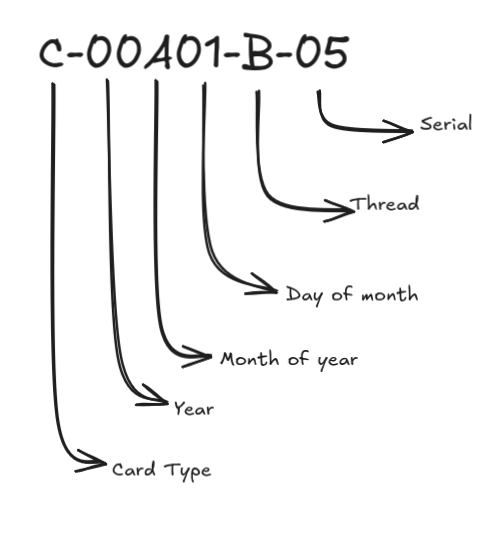
All that results in a fairly meaningful id that packs a lot of information and helps me rediscover thought pathways and gives me a quick sense of time elapsed, and time locality for when I wrote that card.
Shifting relationships
Earlier I said that I moved cards for relationships out into their own divider. I'm still on the fence about this if i'm being honest and I'm waiting get a feel of how it works once the slipbox is much larger.
The crux of it is that I want to traverse the relationships in the slipbox at times, and I need a separation there in case cards move from cluster to cluster.
So my relationship cards reference the full Arvelie dates + an indicator which cluster those cards exist in. If they're cluster cards I make strong point of writing these in pencil. Having to update these means I get the opportunity to reivew them and see if the relationships still hold, and sometimes it triggers additional linkages or ideas of exploration that I can put in as new cards or seed project cards to research something in more depth.
More boxes
At the moment, my slipbox has around 1,000 cards in it and it's growing by the week. The continual refinement approach i'm taking means sometimes I can be lazy, sometimes i'm not feeling plumbing the depths of some topic, so I bang out a card and shove it into the unassimilated section for future me to discover and see if I have the need to expand it.
If i'm learning a new code concept, I dive in, try it out, work examples, and apply it in domains I have deep understanding in. Through the attempts and failures I get a better understanding of the coding practice, tool, or framework, it's limits, use cases, operating modes and how it comes apart at the seams.
I didn't have a way to do that same process for non-programming tasks, and i'm sad I didn't realize that sooner in my life.
This slipbox system, as well laid out as I have made it, is still rough. It will change. It will evolve to align more and more with what aspects of "things" I find important. I'm looking forward to that, the hard part right now is time. Finding time in a busy, often chaotic family and work life to sit down and think deeply through the slipbox as a tool for thought and exploration. But when I do make timeI feel a larger sense of accomplishment than I have ever felt typing things into the ether.
I'll write more about the process of getting information into the slipbox in a subsequent article. For now i'm trying to get settled into using this thing, and steering it and finding evolutions of it that make it more powerful, as well as getting to grips with the concepts of maintenance that it requires.
_ J